From Parlour Cabinets to Pocket Collections
Trace how parlour cabinets and pocket collections suit different habits, then choose a format that keeps your objects meaningful, accessible and well cared for.
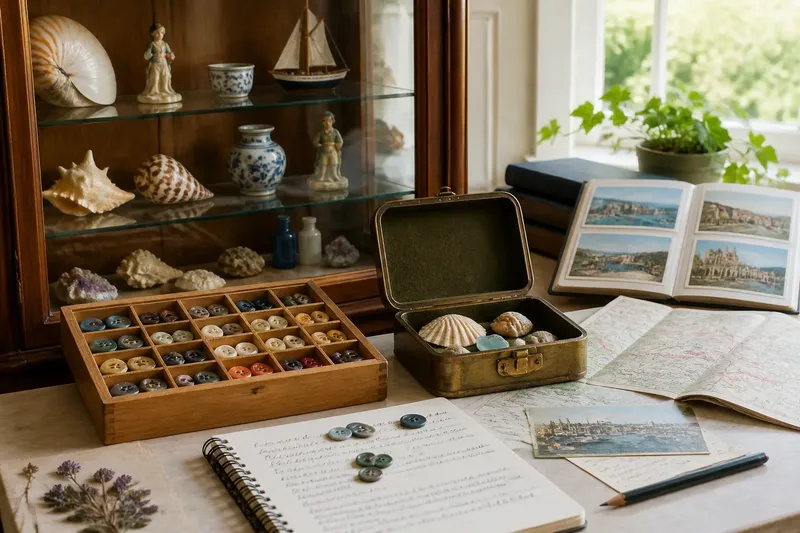
Parlour cabinets and pocket collections reflect different ways of making room for personal objects. A cabinet gave keepsakes a visible place in the home; a pocket collection favours a small selection that can travel or be brought out when wanted.
Neither format simply replaced the other. Albums, drawers, boxes and portable cases offer distinct ways to display, handle and remember things, shaped by the objects themselves and the rooms available to keep them.
Cabinets and parlours
In homes with a room set aside for receiving visitors, a cabinet could make collecting part of hospitality. Shells, ceramics, miniatures and souvenirs could be arranged behind glass, where guests might see them without handling each piece.
The cabinet gave a collection a defined place and a visible order. Its practical limits were just as clear: it took up room, and objects behind glass were less convenient to handle than things kept in a drawer or box.
As a household used rooms for more than one purpose, a dedicated display could become harder to accommodate. Albums made sense for flat keepsakes such as postcards, while boxes and drawers let a collection be stored away and brought out as needed. These forms did not make cabinets obsolete; they gave collectors other ways to keep and revisit objects.
Collections in smaller formats
A pocket collection reduces the selection to a few objects suited to carrying. It can make collecting part of a walk, visit or day out, while leaving delicate or bulky pieces at home. The choice is not only about size: a pocket collection can also centre on a place, a route or a particular kind of encounter.
For example, a folded map marked with visited places records a series of outings without requiring a display case. A small box of sturdy beach finds keeps a chosen group together, while postcards in an album remain easy to compare without being carried loose.
Each format changes how the collection is encountered. A cabinet invites looking; an album invites comparison; a pocket case makes a small selection portable. Keeping those purposes distinct helps prevent a travel pouch from becoming a catch-all for objects that need more protection.
Choose by material
Let the objects guide their storage. A paper ticket, a fragile shell and a smooth stone have different needs, and a format that suits one may not suit the others.
- Small, sturdy objects: Check whether the items roll or become mixed together; if they do, use a divided tray or small box, and if they stay sorted, keep the simpler container.
- Flat paper items: Check for bent corners, loose pieces or contact with rough surfaces; if any are present, use an album or suitable sleeve, and if the papers are already protected and easy to compare, retain their current arrangement.
- Fragile objects: Check for movement, contact with neighbouring items or dust; if any pose a concern, choose a stable enclosed place with room around each piece, and if the current display is secure, avoid unnecessary handling.
- Items with personal stories: Check whether you can identify each item’s source or occasion; if you can, write a brief note and keep it with the object, and if you cannot, mark the detail as unknown rather than guessing.
- Portable selections: Check whether an item can tolerate ordinary carrying and whether its container keeps it from rubbing against other objects; if not, leave it at home, and if it is sturdy and contained, include it in the travel selection.
- Natural or cultural objects: Check whether the item may have specific care or collection requirements; if you are unsure, consult appropriate local guidance or a qualified specialist, and if you know the relevant conditions, follow them before storing or carrying it.
For keepsakes that may be affected by ordinary paper, use acid-free paper where appropriate. Avoid packing objects tightly together, and seek a conservator’s advice for material-specific care when the object is fragile or valuable.
A considered change
Before buying a cabinet or a set of cases, observe how you use one group of objects. Note what you look for, what you handle and what you want to see; this helps distinguish a display problem from a storage problem.
Say you have a jam jar of buttons from family sewing tins, but you cannot remember which buttons came from which tin. You sort them on a clear table, notice that you mainly compare colours, and place the groups in a divided box. You write down the source you can identify and mark the rest as uncertain. The result is a collection that is easier to compare, with its known history kept alongside it; the trade-off is that the buttons are no longer visible on a shelf.
For a display, choose a small group and leave space around it. Keep the rest in suitable storage, and rotate pieces only when you can do so without creating a difficult sorting task. A modest handwritten label can explain a connection, but uncertain dates or origins should remain clearly uncertain.
Questions about scale?
How do I choose a cabinet or box?
Start with fragility, shape and how often you handle the objects, then consider how much room the container will occupy. Choose a format that lets you retrieve items without forcing them together; if you are unsure, try a temporary box before committing to furniture.
Should I display every item?
No: a selected group can be easier to look at than a crowded surface. If the remaining objects stay organised and accessible, rotate the display when your interest changes; if rotation creates confusion, keep a smaller fixed group.
What belongs in a pocket collection?
Choose compact, sturdy objects or protected paper keepsakes that can tolerate carrying. If an item is fragile, valuable or irreplaceable, leave it at home and carry a note or photograph instead if you need a reminder.
How can I record an item’s origin?
Write down the source, place or occasion while you can identify it, then keep the note with the object or its container. If the detail is uncertain, say so rather than filling the gap with a guess.
Keep a useful scale
A pocket collection works best as a deliberate selection, not a smaller version of everything on a shelf. Before an outing, decide what kind of find belongs in it and where temporary keepsakes will go when you return home.
Matching labels, elaborate cases and a complete catalogue are not worth the effort before you know what the collection needs. Begin with a clear container, a pencil note and a practical place to display or store the objects. For parlour cabinets and pocket collections alike, the useful question is whether the format lets you encounter the things you keep while protecting their material and meaning.